Management

Analytics, Management

Beginner Kobo Collect Tutorial: Complete Guide to Digital Data Collection

If you are looking for a Kobo Collect data collection guide, you are in the right place. If you are searching for a Beginner Kobo Collect tutorial, this guide will walk you through everything you need to know about digital data collection using Kobo Collect. Many researchers, NGO professionals, students, and field officers still rely on paper questionnaires. While paper surveys may seem simple, they often lead to printing costs, missing responses, manual data entry errors, and slow analysis. This Beginner Kobo Collect tutorial will help you understand how to move from traditional paper surveys to efficient, mobile-based data collection using Kobo Collect and KoboToolbox. By the end of this guide, you will confidently know how to design, deploy, and manage digital surveys in real-world projects. What Is Kobo Collect? Kobo Collect is a free Android application designed for field data collection. It works together with KoboToolbox, an online platform where you create and manage surveys. You can visit the official KoboToolbox website here:https://www.kobotoolbox.org With Kobo Collect, enumerators can: This is why many development organizations, universities, and monitoring teams rely on it. If you’re new to digital surveys, this Beginner Kobo Collect tutorial will simplify the learning process. Why This Beginner Kobo Collect Tutorial Recommends Digital Data Collection Paper surveys create delays and risks. Here’s why digital tools are better: 1. Offline Functionality Data can be collected in remote areas without internet access. 2. Automatic Validation Mandatory questions reduce missing responses. 3. Smart Skip Logic Questions automatically adjust based on earlier responses. 4. Real-Time Monitoring Supervisors can track submissions instantly from the dashboard. 5. GPS & Metadata Capture You can verify interview locations and timing. For professionals who care about accuracy and efficiency, this is a game changer. If you’re also interested in designing better survey questions, reach out to us for a comprehensive guide on designing optimal questionnaires. Step-by-Step Beginner Kobo Collect Tutorial Here is the practical process explained clearly: Step 1: Create a KoboToolbox Account Sign up for free on the KoboToolbox website. Step 2: Design Your Survey Use the online form builder. It is beginner-friendly and does not require coding. For detailed technical documentation, you can explore:https://support.kobotoolbox.org Step 3: Deploy the Form Click “Deploy” to activate the survey. Step 4: Install Kobo Collect Download the Kobo Collect app from the Google Play Store. Step 5: Connect the Application Enter your server URL and login credentials. Step 6: Download the Form Enumerators download the deployed form onto their smartphones. Step 7: Collect and Upload Data Complete interviews offline and upload submissions when internet becomes available. This Beginner Kobo Collect tutorial simplifies what initially appears technical. Real-Life Application of This Beginner Kobo Collect Tutorial Let’s imagine you are conducting a County Development Survey assessing: Instead of printing 1,000 questionnaires: Within one week: No manual data entry. No stacks of paper. No long delays. This is the real-world value of following a structured Beginner Kobo Collect tutorial. Best Practices in This Beginner Kobo Collect Tutorial To achieve professional results: Digital tools improve quality but preparation still matters most. If you want to understand broader digital research tools, you can reach us out.  Common Mistakes Beginners Should Avoid Even with a good Beginner Kobo Collect tutorial, beginners sometimes: Avoid these mistakes and your data collection process will run smoothly. Who Should Use This Beginner Kobo Collect Tutorial? This guide is ideal for: Digital data collection is quickly becoming the professional standard.
Analytics, Management

How to Develop an M&E Framework & Choose Key Indicators: A Practical Guide for NGOs in Africa

Introduction In today’s African development space, NGOs and donors alike face mounting pressure to demonstrate results, show credible data, and turn insights into action. A robust Monitoring & Evaluation (M&E) framework is no longer optional but rather essential. Yet too many NGOs launch projects with weak or ad-hoc measurement systems, which undermines learning, accountability and funding potential. In this article, you’ll learn why a strong M&E framework matters, what it should include, and how you can develop one, especially in the context of Sub-Saharan Africa. By the end, you’ll be equipped to choose key indicators that are realistic, relevant and donor-ready. At Terabyte Data & Communications Ltd., we support NGOs and donors with just these tools. What is an M&E (or MEL) Framework? An M&E framework (sometimes a MEL framework ) is essentially a roadmap for measuring your programme. It links your strategy (what you want to change) with what you do (activities), and outlines how you will track progress (indicators, data sources, timing) and learn from your data. It is distinct from an M&E plan (which is more detailed operationally) and from a log-frame (which is often more donor-focused). According to guidance from the Organisation for Economic Co‑operation and Development (OECD), an M&E framework lays out the logic of your intervention and the indicators you’ll use. For NGOs in Africa, a strong framework helps to: Align your activities with measurable outcomes and impact; Support donor confidence by presenting credible data; Embed learning and adaptation rather than just compliance; Build a sustainable measurement system despite resource constraints.Indeed, as the FundsforNGOs platform notes: “M&E serves as a critical framework that enables NGOs to assess their programmes’ effectiveness, efficiency and relevance.” Core Components of an Effective M&E Framework Here are the key building blocks you should include in your framework: 1. Theory of Change / Results Chain Start by mapping how change is expected to happen: Inputs → Activities → Outputs → Outcomes → Impact. The theory of change describes assumptions and context behind these links. Without this, you cannot properly evaluate. For example: training youth (activity) leads to a number certified (output) leads to improved employment (outcome) leads to enhanced livelihoods (impact). 2. Indicators for Each Level At each level of the chain you’ll need indicators: output indicators (what you directly deliver), outcome indicators (what change occurs), impact indicators (long-term results). A guide by DGMT emphasises this structure. 3. Data Sources, Baseline, Targets, Frequency & Responsibility Every indicator needs clarity on: where the data comes from, what the baseline value is, what target you aim for, how often you’ll measure, and who is responsible. Also include disaggregation (e.g., by gender or region) if relevant. Reliable data depends on these clear definitions. 4. Methods & Tools for Collection, Analysis & Learning Define methods (surveys, focus groups, mobile data collection), tools (KoboToolbox, CommCare), how you’ll analyse data (dashboards, visualization), and how you’ll use it for learning and not just reporting. Learning loops are critical in NGO contexts, and doing this well differentiates top-performing organisations. 5. Reporting & Feedback Loops A framework isn’t complete unless you specify how results will be communicated to stakeholders (donors, beneficiaries, board), and how feedback will inform adaptation. Good frameworks build in regular review meetings and updates to respond to evolving context. How to Choose Key Indicators: Practical Guidance Selecting the right indicators is one of the most common challenges. Here’s how you can make wise choices: Relevance & Context: Ensure indicators reflect what your programme truly aims to change, and align with local context (not just donor templates). SMART Criteria: The indicator should be Specific, Measurable, Achievable, Relevant, Time-bound. Many guides stress this. Balance Quantity & Quality: Too many indicators can overload staff, system and budget. As one practitioner noted: “Keep it simple … each outcome doesn’t need dozens of indicators.” Mix Quantitative & Qualitative: Numbers tell part of the story, but qualitative insight (stories, perceptions, behaviour change) enriches understanding of outcomes. DGMT emphasises indicator sets for complex phenomena. Alignment with Levels: Make sure each indicator corresponds to the correct level in your results chain (output vs outcome vs impact). Feasibility: Consider your data collection capacity, technology, connectivity (especially relevant for African NGOs working in remote areas). Donor & Internal Use: Choose indicators that satisfy donor reporting requirements and help your organisation learn, adapt and improve. Example Template: Developing Your M&E Framework (with an African NGO Lens) Here’s a practical workflow tailored to African NGO realities: Engage stakeholders & map your theory of change – include staff, community reps, partners to secure buy-in and contextual relevance. Define your key objectives/outcomes – make them clear, measurable and realistic. Select key indicators – use the guidance above to choose indicators that matter. Build your indicator matrix/table – include baseline, target, data source, frequency, responsibility. Plan data collection & systems – considering mobile/data-offline tools, training data collectors, ensuring quality. Implement & monitor – start collecting data, review regularly, check data quality. Analyse & use data for learning – set up dashboards, monthly/quarterly review meetings, adapt programme accordingly. Report & communicate – to donors, beneficiaries, board, use visuals, stories and numbers. Review & revise the framework – as context changes (e.g., funding shifts, local conditions evolve), adjust indicators, targets or methods. In Africa, key challenges you should account for: connectivity issues, limited staff capacity, multiple donor demands, cultural/language diversity, remote monitoring. By anticipating these in your framework design, you increase feasibility and impact. Common Pitfalls & How to Avoid Them Too many indicators → overload and low data quality. Focus on key measures. Indicators not linked to your logic chain → you may collect data but not measure meaningful change. Indicators not measurable or vague → they become meaningless (e.g., “increase youth empowerment” without measurable indicator). No baseline or target → you cannot assess change over time. Data collection not feasible → remote areas, poor connectivity, low capacity can sabotage good frameworks. Framework built only for donor reporting → neglects organisational learning and adaptation. Lack of stakeholder involvement/local ownership → reduces relevance and data use. Ignoring

Analytics, Management

Turning Data into Action for a Sustainable Future, How Data Is Transforming Kenya’s Food Systems

In a country where climate change, rising food prices, and nutritional gaps threaten livelihoods, data is emerging as the tool that could tilt the scales. The Kenya Food Systems Dashboard (KFSD), launched in February 2024 by the Ministry of Agriculture and Livestock Development, brings together a rich collection of indicators aimed at giving policymakers, NGOs, businesses, researchers, and citizens a clear picture of Kenya’s food system. This blog explores what KFSD is, why it matters, how Terabyte Data & Communications Ltd aligns with its promise, and what lies ahead in turning insights into action. What is the Kenya Food Systems Dashboard (KFSD)? The Kenya Food Systems Dashboard (KFSD) is a digital platform aggregating data from multiple sources to provide a full view of Kenya’s food system. From production and supply chains to nutrition outcomes and drivers of change. It covers six main areas: Drivers, Food Supply Chain, Food Environments, Individual Factors, Outcomes, and Cross-Cutting Issues. KFSD includes over 70 data visualizations and diagnostics, with county-level insights to allow stakeholders to compare performance across Kenya’s 47 counties. It is intended to support decisions, diagnose weaknesses, and guide policies. Why Data-Driven Systems Matter for Kenya’s Future Kenya is facing multiple interconnected challenges: climate stress on agriculture, fluctuating input costs, food insecurity, and a burden of malnutrition. In this context, data systems like KFSD are more than nicecities. They are essential infrastructure. With access to timely, reliable data, decision makers can detect risks early, allocate resources more efficiently, and design interventions that match actual needs instead of assumptions. For example, the dashboard provides indicators like maize value of total production, beans production value, or rice area, across counties. These help monitor trends, spot production decline or surges, and understand regional food supply bottlenecks. The Bigger Picture, From Data to Decision Making The KFSD doesn’t just collect data but it helps translate it into policy, planning, and action. It aligns closely with national strategies like the Agricultural Sector Transformation and Growth Strategy (ASTGS) and the National Food and Nutrition Security Policy.County governments can use the Dashboard’s diagnostics to identify underperforming areas in nutrition or agricultural productivity. NGOs and donors use it to monitor impact and guide investment. Businesses can see food supply chain gaps or opportunities for innovation. In sum, data comprehension, comparison, and diagnostics pave the path for inclusive, sustainable food systems. Turning Data into Action At Terabyte Data & Communications Ltd, we believe in evidence-based solutions. The success of KFSD underscores the potential of integrating monitoring & evaluation, environmental data analysis, and capacity building. Our services are built for this moment. Whether supporting agriculture, environmental assessment, or social programs, Terabyte helps organizations: Design data collection systems that feed dashboards like KFSD Analyze indicators to reveal actionable insight Build local capacity so that teams at county level can use data dashboards effectively Ensure that policy, planning and project implementation are grounded in reality We see KFSD not simply as a government tool, but as a model for what data-driven governance can be in Kenya and beyond. Challenges and the Road Ahead Despite its strengths, several challenges remain. Infrastructure gaps (internet, data collection tools) limit real-time updates in some counties. Data literacy varies widely; many local actors need training to interpret and act on indicators. Policy alignment and resource commitment are still uneven, especially for cross-cutting issues like nutrition or climate resilience. Overcoming these challenges requires investments in digital infrastructure, strong training programs (capacity building), supportive policies, and partnerships among government, private sector, and communities. Terabyte is prepared to help bridge those gaps through our consultancy in monitoring & evaluation, research, environmental impact assessments, and training programs. Conclusion Kenya’s journey toward sustainable, equitable food systems is gaining momentum through data-driven initiatives like the Kenya Food Systems Dashboard (KFSD). By consolidating vast datasets into a single, accessible platform, Kenya has taken a major step toward informed decision-making in agriculture, nutrition, and climate resilience. Yet, real transformation depends on how well stakeholders such as policymakers and local organizations can interpret and act upon these insights. As Kenya and the broader East African region continue embracing evidence-based governance, collaboration will be key. We invite development partners, government agencies, and private-sector actors to work with us in building data systems that inform, inspire, and create real change. Together, we can turn insights into sustainable solutions because the future of Kenya’s food systems will be written in data, but powered by people.

Analytics, Finance, Management

How NGOs in Kenya Can Use Social Return on Investment (SROI) to Build Donor Trust and Accountability

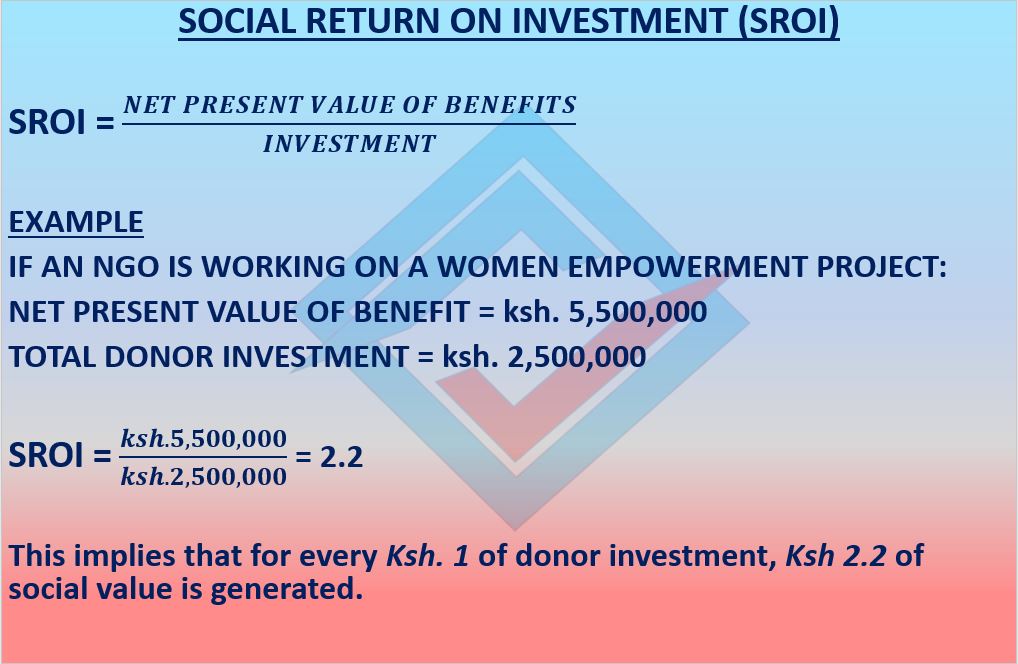
Learn how NGOs in Kenya can use Social Return on Investment (SROI) to measure real impact, improve accountability, and strengthen donor relationships. Includes a real example from Maralal, Samburu. Why SROI Matters for NGOs in Kenya In Kenya’s fast-evolving nonprofit sector, donors and stakeholders are increasingly asking a critical question: “What real difference does our funding make?”To answer this effectively, many NGOs are turning to Social Return on Investment (SROI). This is a framework that quantifies social and environmental outcomes in financial terms, translating impact into values donors easily understand. SROI goes beyond traditional reporting by capturing both tangible and intangible benefits, such as improved livelihoods, empowerment, and environmental sustainability. All these are key priorities for NGOs operating across East Africa and the world at large. What Is Social Return on Investment (SROI)? SROI is an impact measurement approach that calculates the social, environmental, and economic value generated from each shilling invested in a project. The SROI formula is simple: However, applying SROI involves systematic steps — identifying stakeholders, mapping outcomes, assigning financial proxies, and applying impact-adjustment factors like deadweight, attribution, and drop-off to ensure accuracy and credibility. Example of SROI Methodology (Step-by-Step) Identify stakeholders: Who benefits directly and indirectly (e.g., women groups, youth, communities, local authorities). Map inputs: Determine the total investment (money, time, or resources). Measure outcomes: Gather data on measurable results (income increase, health improvement, education access). Assign financial proxies: Convert social outcomes into financial values (e.g., savings, earnings, cost reductions). Apply adjustments: Deduct percentages for what might have happened anyway (deadweight), contributions from other actors (attribution), and decline over time (drop-off). Calculate SROI ratio: Divide the total adjusted value by the initial investment. Practical Example: Measuring SROI in Maralal, Samburu In 2023, a local NGO in Maralal, Samburu County, launched a Women’s Livelihood and Solar Empowerment Project to enhance income and resilience among pastoralist women affected by recurrent droughts.The project invested KSh 5.5 million, covering solar equipment, training, and microfinance for women cooperatives. After two years, an independent evaluation using SROI methodology revealed: Impact Area Description Financial Proxy (KSh) Increased household income 120 women increased income from KSh 2,000/month to KSh 7,500/month 7.9 million Reduced fuel expenses Households saved KSh 500/month from solar lighting 1.8 million Improved girls’ study hours 70 households reported increased school attendance 0.7 million Health cost reduction Fewer smoke-related illnesses 0.5 million Total social value: KSh 10.9 million Adjustments were then made for: Deadweight (10%) – benefits that would have occurred anyway Attribution (25%) – contribution of other stakeholders Drop-off (15%) – decline in value over time Adjusted total value = 10.9M × (1 – 0.10 – 0.25 – 0.15) = 6.54M Interpretation:For every KSh 1 invested, the project generated KSh 1.19 in measurable social value  showing a positive, evidence-based impact. These results convinced the donor to extend funding by three years, and the NGO was recognized by the County Department of Gender and Social Services as a model for community-led sustainability. Why SROI Builds Donor Trust and NGO Credibility SROI makes NGO reporting more transparent, data-driven, and relatable.For donors, seeing concrete ratios and verified data builds confidence that funds are being used effectively.For NGOs, SROI serves as a strategic communication tool — one that connects human stories with measurable results, making impact reporting more compelling and professional. It also strengthens internal decision-making, helping teams prioritize projects with the highest social and financial value. Implementing SROI in Your Organization To get started, NGOs can: Integrate SROI into project design — plan data collection and outcome tracking from the start. Train staff in SROI methodology — combine M&E skills with financial and social analysis. Leverage digital dashboards — use visualization tools to communicate results effectively. Collaborate with local stakeholders — ensure that social values reflect community realities, especially in rural Kenya and East Africa. If your organization operates in Kenya or East Africa, investing in SROI can significantly enhance your visibility, improve donor relations, and promote evidence-based accountability. Conclusion SROI is more than just a financial ratio, it is rather a storytelling framework grounded in evidence.By adopting SROI, NGOs in Kenya can not only quantify their social impact but also inspire confidence among donors, policymakers, and communities. If you want to take your NGO’s accountability to the next level, start exploring consultancy services today and turn your impact stories into powerful, data-backed success narratives.

error: Content is protected !!
Scroll to Top