Why SROI Matters for NGOs in Kenya
In Kenya’s fast-evolving nonprofit sector, donors and stakeholders are increasingly asking a critical question: “What real difference does our funding make?”
To answer this effectively, many NGOs are turning to Social Return on Investment (SROI). This is a framework that quantifies social and environmental outcomes in financial terms, translating impact into values donors easily understand.
SROI goes beyond traditional reporting by capturing both tangible and intangible benefits, such as improved livelihoods, empowerment, and environmental sustainability. All these are key priorities for NGOs operating across East Africa and the world at large.
What Is Social Return on Investment (SROI)?
SROI is an impact measurement approach that calculates the social, environmental, and economic value generated from each shilling invested in a project.
The SROI formula is simple:
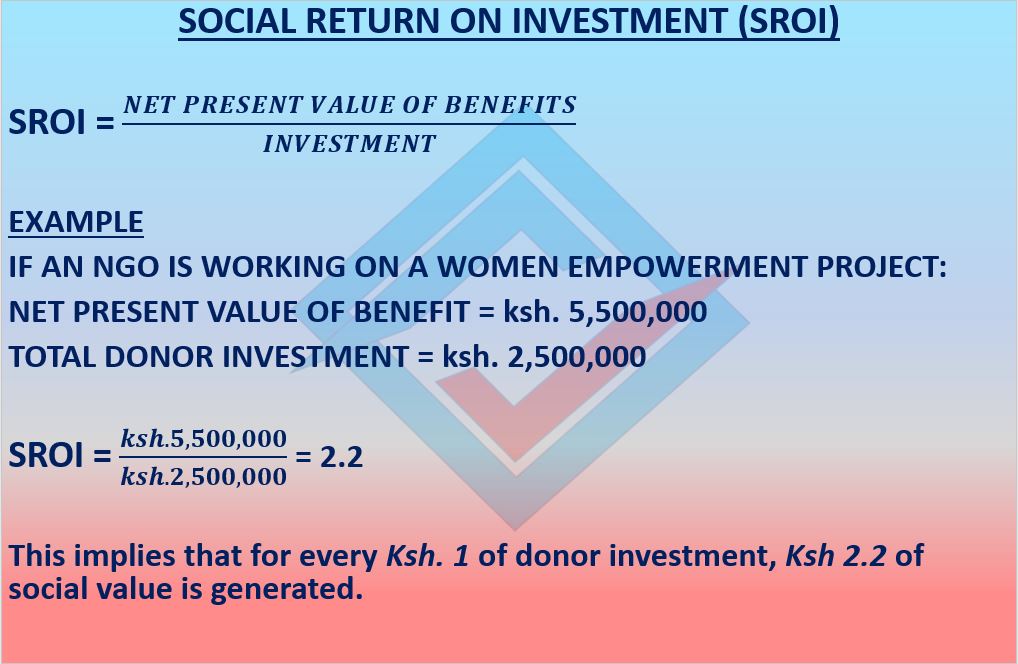
However, applying SROI involves systematic steps — identifying stakeholders, mapping outcomes, assigning financial proxies, and applying impact-adjustment factors like deadweight, attribution, and drop-off to ensure accuracy and credibility.
Example of SROI Methodology (Step-by-Step)
Identify stakeholders: Who benefits directly and indirectly (e.g., women groups, youth, communities, local authorities).
Map inputs: Determine the total investment (money, time, or resources).
Measure outcomes: Gather data on measurable results (income increase, health improvement, education access).
Assign financial proxies: Convert social outcomes into financial values (e.g., savings, earnings, cost reductions).
Apply adjustments: Deduct percentages for what might have happened anyway (deadweight), contributions from other actors (attribution), and decline over time (drop-off).
- Calculate SROI ratio: Divide the total adjusted value by the initial investment.
Practical Example: Measuring SROI in Maralal, Samburu
In 2023, a local NGO in Maralal, Samburu County, launched a Women’s Livelihood and Solar Empowerment Project to enhance income and resilience among pastoralist women affected by recurrent droughts.
The project invested KSh 5.5 million, covering solar equipment, training, and microfinance for women cooperatives.
After two years, an independent evaluation using SROI methodology revealed:
| Impact Area | Description | Financial Proxy (KSh) |
| Increased household income | 120 women increased income from KSh 2,000/month to KSh 7,500/month | 7.9 million |
| Reduced fuel expenses | Households saved KSh 500/month from solar lighting | 1.8 million |
| Improved girls’ study hours | 70 households reported increased school attendance | 0.7 million |
| Health cost reduction | Fewer smoke-related illnesses | 0.5 million |
Total social value: KSh 10.9 million
Adjustments were then made for:
Deadweight (10%) – benefits that would have occurred anyway
Attribution (25%) – contribution of other stakeholders
Drop-off (15%) – decline in value over time
Adjusted total value = 10.9M × (1 – 0.10 – 0.25 – 0.15) = 6.54M
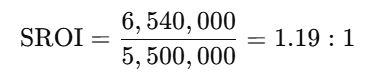
Interpretation:
For every KSh 1 invested, the project generated KSh 1.19 in measurable social value showing a positive, evidence-based impact.
These results convinced the donor to extend funding by three years, and the NGO was recognized by the County Department of Gender and Social Services as a model for community-led sustainability.
Why SROI Builds Donor Trust and NGO Credibility
SROI makes NGO reporting more transparent, data-driven, and relatable.
For donors, seeing concrete ratios and verified data builds confidence that funds are being used effectively.
For NGOs, SROI serves as a strategic communication tool — one that connects human stories with measurable results, making impact reporting more compelling and professional.
It also strengthens internal decision-making, helping teams prioritize projects with the highest social and financial value.
Implementing SROI in Your Organization
To get started, NGOs can:
Integrate SROI into project design — plan data collection and outcome tracking from the start.
Train staff in SROI methodology — combine M&E skills with financial and social analysis.
Leverage digital dashboards — use visualization tools to communicate results effectively.
Collaborate with local stakeholders — ensure that social values reflect community realities, especially in rural Kenya and East Africa.
If your organization operates in Kenya or East Africa, investing in SROI can significantly enhance your visibility, improve donor relations, and promote evidence-based accountability.
Conclusion
SROI is more than just a financial ratio, it is rather a storytelling framework grounded in evidence.
By adopting SROI, NGOs in Kenya can not only quantify their social impact but also inspire confidence among donors, policymakers, and communities.
If you want to take your NGO’s accountability to the next level, start exploring consultancy services today and turn your impact stories into powerful, data-backed success narratives.

That was very helpful
Thank you for the positive comment and welcome to terabyte data & communications Ltd for partnerships and consultancy services.https://www.terabyte.co.ke/