
Baringo Decides their next Senator following the Demise of Hon. Cheptumo
Introduction
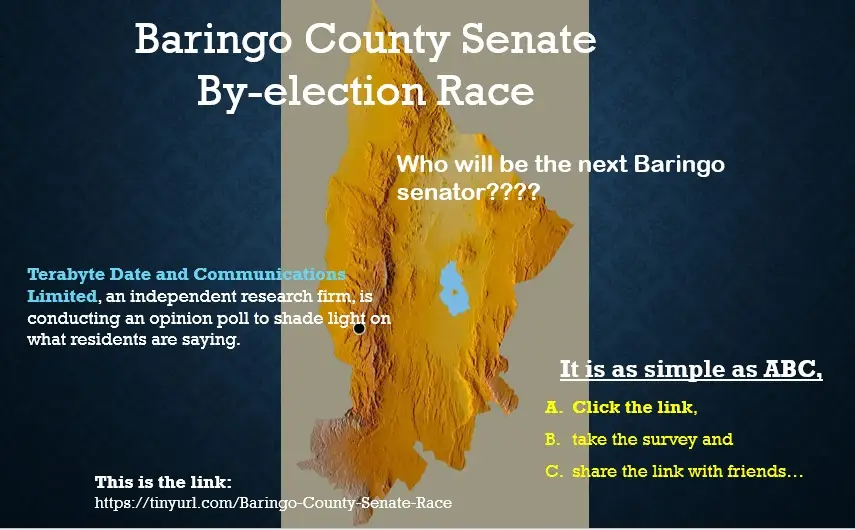
The Baringo County Senate By-Election Poll Survey was conducted between September 4th and 14th, 2025. The goal was to understand voter opinions before the UDA Party primaries.
Ethical research standards were followed. Participants gave informed consent, and only registered voters aged 18 years and above took part. To protect privacy, only coded data was collected.
The survey link was shared widely through Facebook and WhatsApp. Social media influencers helped promote the link to build trust among voters. Respondents came from all six sub-counties: Baringo Central, Baringo North, Baringo South, Eldama Ravine, Mogotio, and Tiaty.
Participant Demographics
A majority of participants were young voters. About 73.3% were aged 18–34 years, 22.4% were between 35–50 years, and 4.3% were above 50 years.
This result reflects Kenya’s overall population trend where the youth make up most of the voting population.
By region, Baringo North (79%) and Mogotio (78.1%) had the highest number of young voters. Tiaty had more middle-aged respondents at 40%.
Most Preferred Candidate
When asked who best represents the needs of residents, Vincent Chemitei led with 39.4% of total support. Wycliff Tobole followed closely with 33.1%. Other candidates such as Silas Tochim, Reuben Chepsongol, and Daniel Kiptoo each received less than 3% support.
Baringo South: Chemitei 44.8%
Mogotio: Chemitei 50%
Baringo North: Tobole 50%
These numbers show that Chemitei’s support cuts across several sub-counties, while Tobole’s base is strongest in the north.
Candidate Competence and Public Trust
Respondents were also asked which candidate they believed had the highest chance of winning and working effectively with the national government. The results mirrored the earlier trends:
Vincent Chemitei: 40.2%
Wycliff Tobole: 33.7%
Daniel Kiptoo: 10.0%
Evans Mundulel: 6.9%
This suggests that Chemitei not only enjoys grassroots support but is also viewed as having the institutional capacity to navigate government relations.
By Gender:
Among female respondents, 44.4% favored Chemitei and 28.4% supported Tobole. Among male respondents, 39.4% supported Chemitei while 34.7% supported Tobole.
By Age:
Youth (18–34 years): Chemitei (39%), Tobole (36.4%)
Middle-aged (35–50 years): Chemitei (44.7%), Tobole (26.3%)
Older adults (51+): Chemitei (36.4%), Tobole (27.3%)
By Economic Activity:
Farmers favored Chemitei (48.9%) over Tobole (28.4%), suggesting agricultural outreach resonates strongly with rural voters.
Business owners leaned slightly toward Tobole (41%) compared to Chemitei (34.6%).
Employed respondents mirrored the countywide trend, preferring Chemitei (40.5%).
Regional Breakdown: Constituency Insights
Baringo North: Tobole remains dominant at 51.6%, reflecting his established base.
Baringo South: Chemitei leads significantly at 43.1%, supported by younger, more urban voters in Marigat and Mochongoi.
Eldama Ravine: Support is split, with Chemitei at 38.6% and Tobole at 22.9%.
Mogotio: Chemitei commands 50%, indicating strong southern support.
Tiaty: Chemitei leads with 48%, followed by Linus Kamget at 32%, showing emerging new interests in the area.
Interpretation and Trends
The survey points to two major frontrunners—Vincent Chemitei and Wycliff Tobole—whose combined support surpasses 70% of total responses.
The youth-driven engagement in the poll suggests that campaign strategies targeting younger voters, especially through digital platforms, will play a pivotal role in shaping the outcome of upcoming primaries.
Chemitei’s appeal appears cross-constituency, transcending traditional loyalties, while Tobole retains strong regional support in Baringo North and parts of Central.
Methodological and Ethical Note
This poll was conducted with a commitment to ethical research practice:
Informed consent was obtained before participation.
Only respondents aged 18 years and above were included.
Data confidentiality was maintained using anonymous codes.
Digital dissemination was done transparently via social media platforms (Facebook and WhatsApp).
Known social influencers were engaged to enhance credibility and reach across all sub-counties.
The methodology ensured diversity of representation while maintaining data integrity and public trust—key aspects of responsible research in Kenya’s political environment.
Reflection: Understanding Baringo’s Political Landscape
Baringo County’s political dynamics continue to evolve. The UDA Party, being dominant in the region, attracts high voter engagement and candidate competition. The poll results reveal a politically aware electorate that values developmental potential, integrity, and government collaboration.
However, beyond candidate preference, there is a deeper message: voter expectations are shifting toward accountability and inclusiveness. The younger demographic demands candidates who not only represent them but also understand modern governance and technology-driven service delivery.
For future surveys, researchers should consider expanding into in-person interviews and focus groups to triangulate digital insights, particularly for older and rural populations less active online.
Call for Peace and Decorum
As Baringo County heads toward the primaries and the senate by-election, this report urges all political actors and residents to uphold peace, tolerance, and mutual respect. Political competition is healthy for democracy, but violence and intimidation erode community trust.
Let us remember that there is life after elections—neighbors will remain neighbors, and communities must continue working together for shared progress. Civic maturity, peaceful dialogue, and issue-based campaigns are the hallmarks of a progressive and democratic Baringo County.
Conclusion
The Baringo County Senate Poll Survey (September 2025) demonstrates the vibrant political participation among residents, especially the youth. Vincent Chemitei currently leads in popularity and perceived competence, while Wycliff Tobole retains strong local loyalty.
This survey highlights both the promise of youth-driven digital engagement and the importance of data-based political insight in Kenya’s evolving democracy.